|
|
 |
Artificial Intelligence (AI)
How far would you 'trust' AI... |
|
|
|
Can you trust the AI to do its job? It won't crash or throw a wobbly ;)
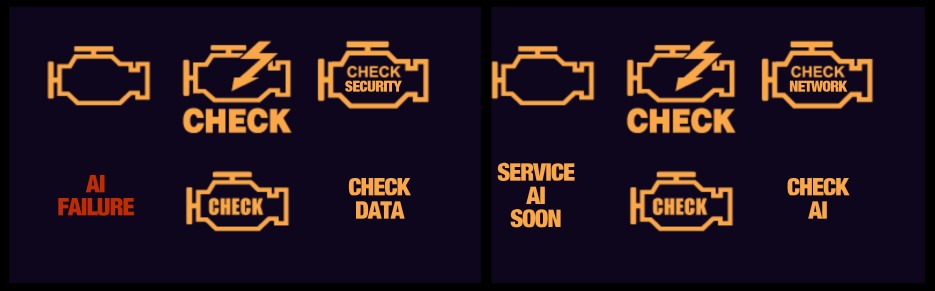
Like your toothbrush, car and fridge freezer - AI system can fail!
The countdown to AI malfunctions is ticking. First off, unlike your typical mechanical failures with their creaks and groans, AI failures can happen silently and swiftly. No warning signs, just a sudden plunge into chaos. And how long before it malfunctions? Well, the clock is ticking from day one. AI systems, no matter how sophisticated, are prone to vulnerabilities that could trigger a catastrophic breakdown at any given moment.
Now, let's talk about robustness. It's not a one-size-fits-all situation. Mechanical failures and AI failures dance to different tunes. While mechanical failures may be due to physical wear and tear, AI failures can be caused by a multitude of factors - data biases, adversarial attacks, or just plain software bugs. The types of robustness required for AI are a complex puzzle that demands a solution beyond the simplicity of nuts and bolts.

AI robustness and reliability is 'not' a one-size-fits-all situation.
And don't you dare confuse AI robustness with reliability. Robustness is about handling the unexpected, the curveballs thrown at your AI system. Reliability, on the other hand, is about consistency and predictability. You might have a robust AI that can handle surprises, but if it's not reliable, it's like having a guard dog that occasionally takes a nap during a break-in.
Now, let's dive into the nitty-gritty of ensuring robust AI models. It's not just about crossing your fingers and hoping for the best. No, you need strategies, my friend. Strategies for model robustness involve rigorous testing, diverse datasets, and continuous monitoring. Handling uncertainty in AI is like walking on a tightrope over a pit of uncertainty - it requires a delicate balance of probabilistic models, uncertainty quantification, and real-world feedback loops.
And here comes the ominous part - reliability testing and verification. Testing in the world of AI is not a luxury; it's a necessity. Imagine unleashing an unreliable AI system into the wild. Chaos ensues. The importance of testing in AI is like the air we breath - essential.
Verification processes for AI systems involve validation at every step, from data collection to model deployment. Trusting an unverified AI is like handing over the keys to your house to a stranger.

Would you trust a stranger with your house or car keys? If you do not test and verify you AI, that is what you are doing!
In the realm of AI, the stakes are high, the risks are real, and the countdown to malfunction never truly stops. It's a world where the line between success and disaster is as thin as a strand of code.
|
|