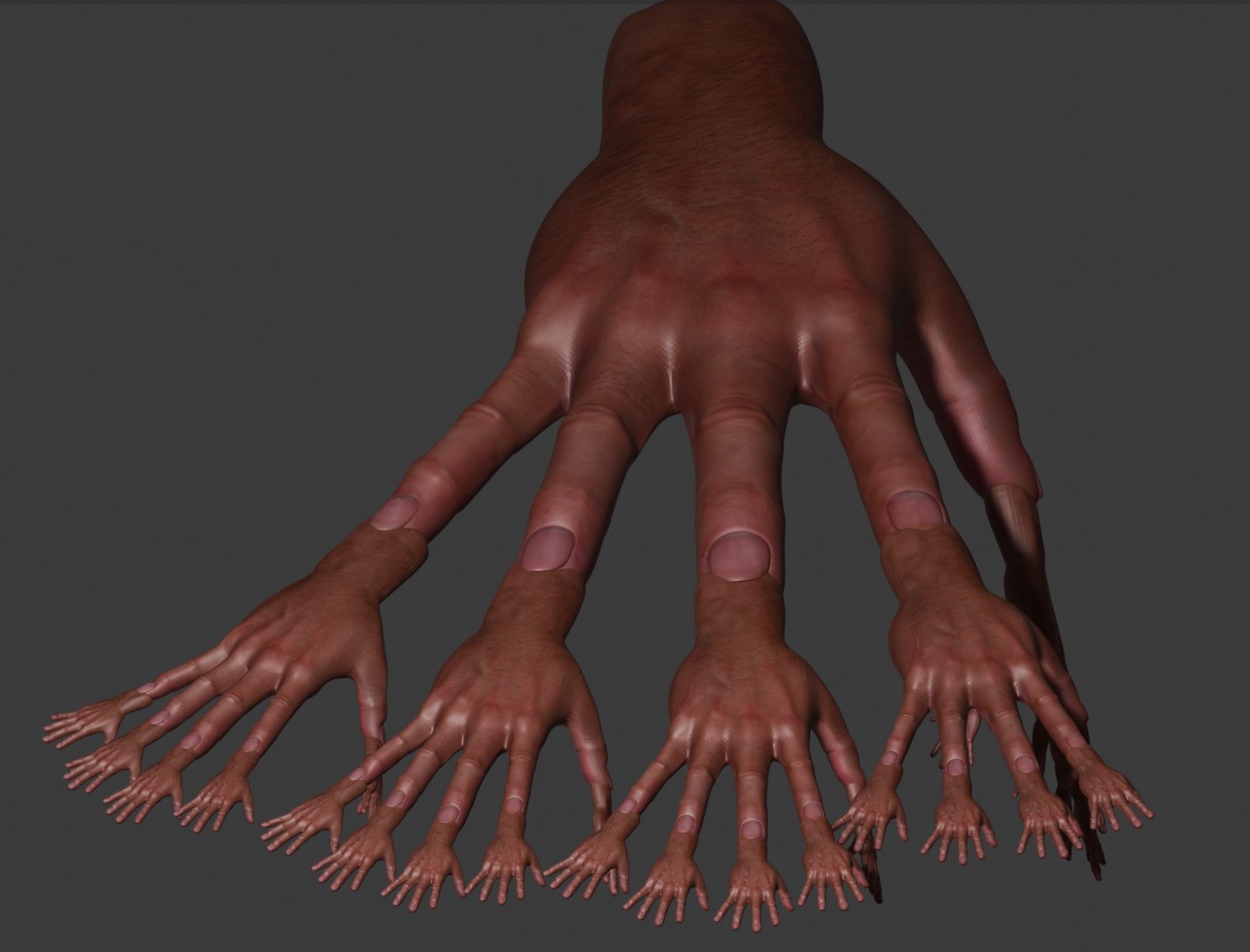
A simple script that takes a mesh (a hand in this case) - and recursively clones it and places it at an offset - which is repeated! This is a fun fractal effect - and is applied to a 'hand' creating hands on fingers.
Hand has little hands on the fingers (depth of 2).
The script is very simple - the only thing you need to be careful about is either infinite recursion or the offsets/scales are wrong.
<?php
import bpy
import math
from mathutils import Vector, Euler

# Settings
base_name = "hand"
max_depth = 2

initial_scale = 1.0
scale_factor = 0.30

offsets = [
    Vector((0, 0, 10)),
    Vector((-0.18,  1.6, 9.4)),
    Vector((-0.2, -1.5, 9.4)),
    Vector((-0.4,  3.0, 8.3)),
    Vector((-2.4, -2.5, 5.7)),
]

rotation_angles = [  # (X, Y, Z) in degrees
    ( 0, 0, 0),
    (-13, 0, 0),
    ( 10, 0, 0),
    ( -30, 0, 0),
    ( 40, 0, -80)
]


# Cleanup: remove all objects except the base
for obj in bpy.data.objects:
    if obj.type == 'MESH' and obj.name != base_name:
        bpy.data.objects.remove(obj, do_unlink=True)

# Locate original
original = bpy.data.objects.get(base_name)
if not original:
    raise ValueError(f"No object named '{base_name}' found.")

original.scale = (1.0, 1.0, 1.0)

def clone_branch(parent_obj, parent_loc, parent_rot, parent_scale, depth):
    if depth == 0:
        return

    for i in range(len(offsets)):
        # Compute new scale
        new_scale = parent_scale * scale_factor

        # Rotate the offset using only the parent’s rotation (not including this level’s rotation yet)
        rotated_offset = offsets[i].copy()
        rotated_offset.rotate(parent_rot)

        # Compute the location
        new_loc = parent_loc + rotated_offset * new_scale

        # Compute new cumulative rotation (after this level's rotation)
        level_rot = Euler([math.radians(a) for a in rotation_angles[i]])
        new_rot = parent_rot.copy()
        new_rot.rotate(level_rot)

        # Duplicate the object
        new_obj = parent_obj.copy()
        new_obj.data = parent_obj.data.copy()
        bpy.context.collection.objects.link(new_obj)

        new_obj.scale = (new_scale,) * 3
        new_obj.location = new_loc
        new_obj.rotation_euler = new_rot

        # Recurse into next level with updated transform
        clone_branch(new_obj, new_loc, new_rot, new_scale, depth - 1)

# Launch the fractal generation
clone_branch(original, original.location.copy(), original.rotation_euler.copy(), 1.0, max_depth)
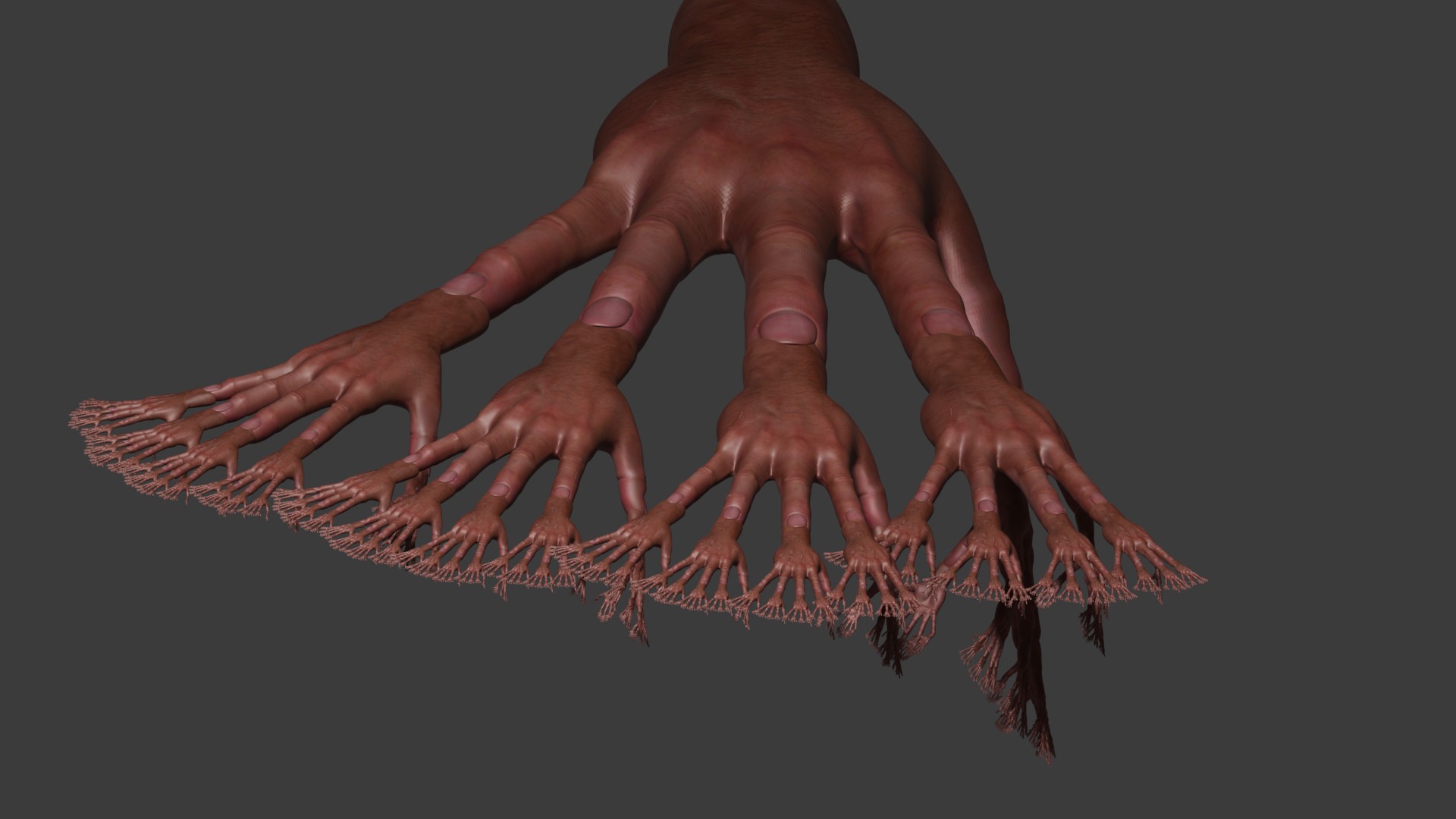
If we go nuts and crank the depth up to 4 - we can get some really little fingers - I mean hands - I mean fingers!!
A fractal depth of 4 for the nested child meshes.
The blender file with the mesh and script can also be downloaded (LINK).
Visitor:
Copyright (c) 2002-2026 xbdev.net - All rights reserved.
Designated articles, tutorials and software are the property of their respective owners.